
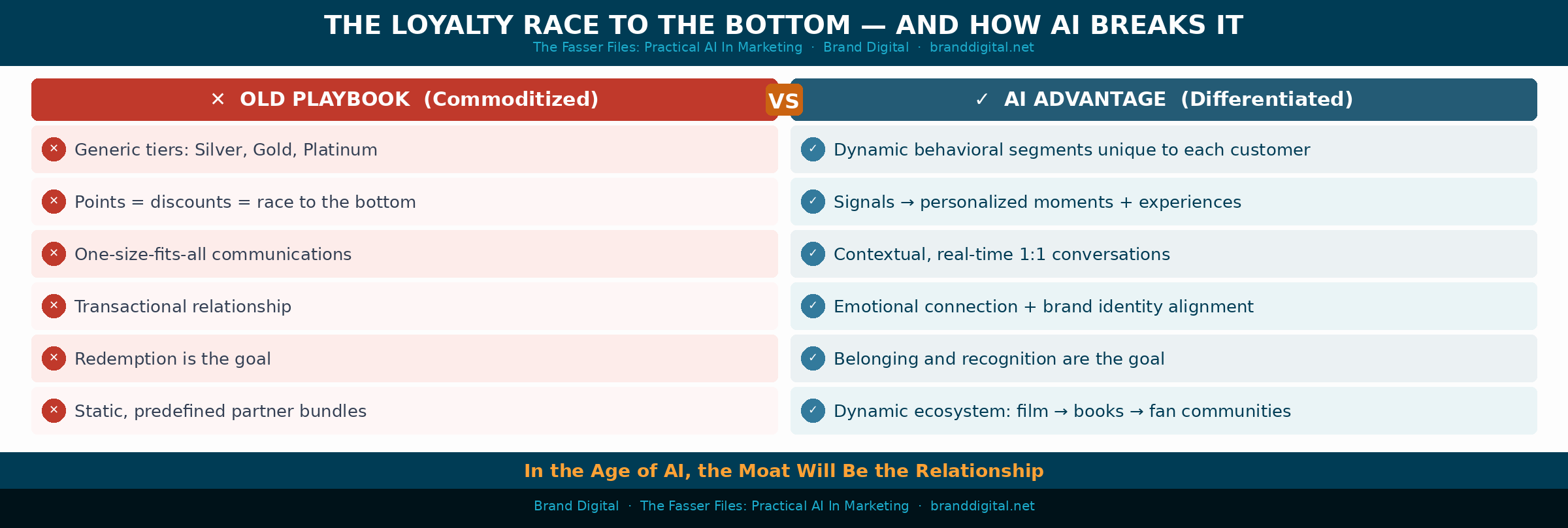
Points and tiers are becoming more commoditized. The brands winning in 2026 are building something competitors can’t copy: a genuine relationship with the consumer powered by modern systems.
In the age of AI, the moat is the relationship.
45%+ of loyalty accounts are inactive. Most of the rest are dormant. And yet brands keep adding tiers, escalating perks, and copying each other. This is leading to a race to the bottom in terms of competing on discounts and freebies. Modern marketing technology and approaches gives us an opportunity to create value for both the brand AND the consumer.
It starts by asking a different question: not how do we encourage and reward transactions? but how do we build a mutually beneficial relationship?
I’ve spent years watching loyalty programs evolve — or more accurately, watching them not evolve. The airline program arms race. The credit card tier inflation. The “exclusive benefits” that are exclusive at three other banks simultaneously. What we’re witnessing is a massive ROI calculation built to squeeze additional sales for the least possible costs. This is a transactional approach that consumers are smart about and treat the brand the way the brand treats them, as a calculation.
We can do better and the shift can be more than incremental – it can be transformative. AI doesn’t just make points programs faster, it makes the entire points paradigm obsolete. Here’s why, and what forward-thinking brands should be doing instead.
01 – The Real Problem Isn’t Points. It’s the Relationship Model.
Points programs aren’t failing because they’re too generous or not generous enough. They’re failing because they encode the wrong relationship. Every point earned broadcasts the same message: we value your transaction and not our relationship. What customers increasingly want to hear is: we value you.
That distinction isn’t philosophical, it’s structural. It’s one of the reasons there are so many loyalty program manipulation calculators and influencers gaming the system. Points and discounts are still important as consumers do care about them, but they should be fuel for the loyalty growth loop not the end all be all purpose of the program.
The five failure modes showing up in loyalty programs right now:
- Points fatigue: Consumers belong to an average of 16+ programs but actively engage with fewer than half. Complexity, expiration policies, and redemption friction drive abandonment faster than any competitor can.
- Commoditization: When every program offers the same basic structure, price becomes the only differentiator. A zero-sum arms race with no winners except the consultants designing the next tier.
- Stickiness complacency: Companies consistently overestimate switching costs and underinvest in their most loyal customers, treating them as a guaranteed asset rather than a relationship to be continually earned.
- Measurement theater: Most programs claim ROI based on the behavior of people who were already loyal. True incrementality — would this customer have bought anyway? — is rarely measured, masking the program’s actual impact.
- Balance sheet liability: Unredeemed points create massive financial obligations that sit on the books like a slow-moving problem no one wants to solve.
Most critically, points-based programs perpetuate a discount-driven relationship. They position the brand as a vendor to be optimized, not a partner to be trusted.
2026 MARKET REALITY
Only 16% of corporations have achieved genuine hyper-personalization, despite having the data and the tooling. The gap between ambition and execution is not a technology problem. It is a strategy and organizational alignment problem. That gap is also your opportunity. (EY Loyalty Report, 2025)
02 – The AI Advantage: From Segments to Signals
The most important shift AI enables in loyalty isn’t automation. It’s the move from demographic segmentation to real-time behavioral intelligence. Instead of grouping customers into broad buckets – “frequent traveler,” “high spender” – AI can process thousands of signals simultaneously to understand what a specific customer needs right now, in this specific context.
The signal framework that’s emerging draws on three data layers working in concert:
- Zero-party data: Preferences, trip purposes, dietary restrictions, and life occasions captured directly through opt-in surveys and conversational interfaces.
- First-party behavioral data: Transaction history, app engagement, browsing patterns, and service interactions within the brand ecosystem.
- Contextual signals: Location, weather, time-of-day triggers, adjacent browsing behavior, and event-based triggers like flight delays, service disruptions, or life milestones.
The best loyalty AI in 2026 is the kind that never announces itself. Members don’t want to experience AI — they want to feel like the brand genuinely gets them.
— Kobie Marketing, 2026
03 – Four Shifts That Separate the Winners
These aren’t incremental improvements to existing programs. They’re structural changes to the loyalty model itself:
TIERS → TRIBES
Identity Over Spend Volume
Dynamic affinity groups — eco-travelers, culinary explorers, digital nomads — that unlock experiences aligned with who customers are, not just what they’ve spent. Mini Cooper built this instinctively. Spotify connects fans to local shows of artists they already love. That’s tribal loyalty: earned through relevance, not rewards calendars.
DISCOUNTS → DELIGHT
The Emotional Multiplier
The hotel that upgrades your room because it knows you always ask for a high floor. The airline that rebooks your connection before you know you’re delayed. These moments don’t require a points ledger. They require attention and AI to act on that attention at scale.
TRANSACTION → TRANSFORMATION
Loyalty as Identity Alignment
Nike Run Club doesn’t give away shoes. It builds community, tracks progress, and aligns with who runners aspire to become. The program earns loyalty by being part of something bigger than a purchase history and AI helps every brand find that identity alignment at individual scale.
GUT FEEL → INCREMENTALITY
Proving Causation, Not Correlation
Most “loyalty ROI” is correlation theater. The spending behavior of loyal customers doesn’t prove the program created that loyalty. AI-powered controlled experiments — randomized holdouts, propensity-score matching — isolate the program’s actual causal effect. That’s how you earn continued investment.
04 – What Real Personalization Actually Feels Like
Abstract frameworks only go so far. Here’s the concrete difference in practice:
THE NICARAGUA SCENARIO
Generic program: A family books flights to Nicaragua. They receive a confirmation email with a points balance update and an offer for a hotel partner they’ll never use.
Signal-based AI program: The same booking triggers recognition of family configuration (two adults, two children under 12), destination context (Central America, off-season), health requirements (vaccination advisories), and past trip patterns (activity-heavy, outdoors-focused). The response: a curated pre-departure guide covering required vaccines, age-appropriate activities, local weather, travel insurance options matched to the family profile, and a packing checklist.
That’s not a feature. That’s a relationship. The brand didn’t process a transaction — it demonstrated that it was paying attention. The customer didn’t experience “AI” — they experienced a brand that gets them.
THE INVISIBLE LOYALTY PRINCIPLE
The most effective programs in 2026 don’t feel like programs at all. They operate seamlessly in the background — delivering relevant moments, respecting privacy, reducing friction at every turn. When a customer thinks “this brand just gets me” — that’s the goal. Not “I have 4,200 points.”
Ecosystem extension is the next frontier here. A streaming service’s loyalty shouldn’t just reward viewing hours — it should extend naturally into books (the source novel), fan communities, merchandise, and theatrical releases. The brands that map their customers’ identity landscape and build partnerships into that space will build loyalty that feels like belonging, not a rewards calendar.
05 – The Business Case: 2026 Numbers
The strategic argument is clear. The financial case is compelling. Recent research validates every element of this shift:
80% more spend from emotionally-connected loyalty members vs. non-members
EY Loyalty Report, 2025
50% CLV increase for organizations deploying AI-driven loyalty strategies
Netguru, 2026
39.6% of consumers more likely to join a loyalty program explicitly powered by AI personalization
Netguru, 2026
30% churn reduction for brands using predictive analytics and Next Best Action frameworks
Netguru, 2026
And the one that frames the opportunity most starkly: 58% of brands identify personalization as their top loyalty investment — yet only 16% have achieved it. The runway is real. The brands that close this gap in the next 12–18 months will have a head start that looks, from the outside, a lot like an insurmountable advantage.
06 – The Moat Is the Relationship
Here’s the strategic reality most loyalty teams haven’t fully internalized: consumer AI agents are coming for your points arithmetic.
As customers increasingly use AI assistants to compare and optimize loyalty value, programs built purely on transactional logic will be commoditized at machine speed. An AI agent can evaluate the per-point value of 12 programs in seconds. It cannot evaluate the depth of a relationship, the quality of a community, or the resonance of an identity-aligned experience.
In the age of AI, the competitive moat is not your points currency. It is the depth and authenticity of your customer relationship.
WHERE MOST PROGRAMS ARE — AND WHERE THE OPPORTUNITY LIVES
STAGE 01 – Transact
Points & discounts. Pure reward mechanics.
STAGE 02 – Recognize
Tiers & status based on spend volume.
STAGE 03 – Personalize
AI-driven 1:1 offers & communications.
STAGE 04 – Anticipate
Predictive moments before needs arise.
STAGE 05 – Belong
Identity alignment & community.
← THE MOAT
Most programs today cluster at stages 1 and 2. A few forward-thinking brands are building toward stage 3. The brands executing stages 4 and 5 — using AI to anticipate needs and build genuine belonging — are building something that can’t be copied by adding a new benefit tier next quarter.
Privacy-first data, ecosystem consolidation, and the arrival of AI-savvy consumers are all converging to make the relationship model more valuable — and the pure-transaction model more vulnerable — simultaneously. The window for building this advantage isn’t closing quickly, but it is closing.
The question isn’t whether AI will transform loyalty programs. It already is. The question is whether your brand will use AI to build deeper, more authentic relationships — or simply to optimize discounts faster. One path leads to a moat. The other leads to a faster race to the bottom. The choice is strategically obvious. The execution is where it gets hard.
THE FASSER FILES · FULL RESEARCH
Go Deeper: The Complete White Paper
The condensed version you just read covers the strategic argument. The full white paper includes the complete four-pillar AI loyalty architecture, Relationship Maturity Curve methodology, data supply chain design, Next Best Action implementation frameworks, incrementality measurement methodology, and a step-by-step 2026 roadmap.

 Advocacy Through Social Media
Leave a Reply